Electrostatic Generators Explained: From Van de Graaff to Nanogenerators
Electrostatic generators create extremely high voltages without magnets or transformers, using charge accumulation. Explore their principles, classic machines like Van de Graaff and Wimshurst, modern nanogenerators, and their future in micro-power applications. Learn why these devices are vital for science and low-power electronics, but not for large-scale energy generation.

Electrostatic generator technology stands out as a unique method for producing extremely high voltage without relying on traditional transformers or magnetic coils. Unlike conventional power plants that generate energy through rotating turbines and electromagnetic induction, these devices are based solely on the accumulation of electric charge.
Interest in electrostatic generators has persisted for over a century. Iconic devices like the Van de Graaff generator have become symbols of physics laboratories, while modern research explores the use of electrostatic generation in microdevices, sensors, and self-powered electronics.
But is it truly possible to harness energy from static electricity? How efficient are these systems, and do they have a future beyond educational demonstrations? This article delves into how electrostatic machines work, their types, and their development prospects.
What is an Electrostatic Generator?
An electrostatic generator creates electrical energy by accumulating and separating charges, rather than by electromagnetic induction. Instead of using a rotating rotor and magnetic field, these machines build up static electricity to form voltage.
In simple terms, while a regular power plant generates current by moving a conductor through a magnetic field, an electrostatic machine "collects" charges to increase the potential difference between two electrodes.
The main feature of these systems is their ability to produce very high voltage at extremely low current. This distinction defines both their applications and their limitations.
Electrostatic vs. Induction-Based Generation
| Parameter | Electrostatic Generator | Conventional Generator |
|---|---|---|
| Operating Principle | Charge accumulation | Electromagnetic induction |
| Voltage | Very high (hundreds of kV and above) | Medium or low |
| Current | Extremely low | High |
| Power | Low | High |
| Use Cases | Laboratories, accelerators, experiments | Power generation, industry |
That's why electrostatic generators are not used to power cities, but are ideal for creating high-voltage pulses and conducting scientific research.
Where Does the Charge Come From?
The operation of electrostatic generators is based on two main mechanisms:
- Triboelectric effect - transfer of electrons due to friction between different materials (the familiar "static electricity from rubbing").
- Charge induction - redistribution of charges under the influence of an external electric field.
These processes enable the gradual buildup of charge on metallic spheres or disks, increasing the potential difference to millions of volts.
Why Can the Voltage Be So High?
Electrostatic machines are not limited by the magnetic properties of materials like transformers are. The main limit is air breakdown: when voltage gets too high, a spark discharge occurs.
This is why high-voltage generators used in experiments often produce long sparks-a dramatic demonstration of reaching the critical potential difference.
How Does an Electrostatic Generator Work?
To understand how an electrostatic generator functions, it's important to grasp two basic concepts: charge and potential difference.
Voltage is not energy flow itself, but the "pressure" resulting from charge accumulation. The more charges at a point, the higher the potential and the stronger the drive toward discharge.
Step 1: Charge Separation
Every electrostatic generator starts with separating positive and negative charges. This can happen through:
- Friction between materials (triboelectric effect)
- Contact and subsequent separation of bodies
- Electrostatic induction
When two materials touch, electrons move from one to the other, leaving one body with a surplus (negative charge) and the other with a deficit (positive charge).
Step 2: Charge Transfer
After separation, the charge must be moved to the storage electrode. Most designs use:
- Moving belts
- Rotating disks
- Metal brushes or combs
These elements "collect" charge and deliver it to a metal sphere or plate acting as a storage unit.
Step 3: Accumulation and Voltage Increase
When charge reaches the conductive sphere, it spreads across its surface. As charge accumulates:
- The electric field strengthens
- The potential difference rises
- The risk of air breakdown increases
Voltage can reach hundreds of kilovolts or even millions of volts, while the current remains minuscule-making these devices relatively safe when handled properly.
Why Is the Current So Low?
Power is defined by the formula: P = U × I
Even if the voltage (U) is huge, the current (I) in electrostatic machines is extremely low due to:
- Limited rate of charge transfer
- Leakage into the air
- Insulation resistance
That's why electrostatic generation is unsuitable for high-power loads.
The Air Breakdown Limitation
When the electric field reaches the critical value (about 3 kV per millimeter in air), a spark forms. This means the stored charge rapidly discharges.
Electrostatic machines are famous for their spectacular discharges, visually demonstrating the voltage limit that the surrounding environment can withstand.
The Van de Graaff Generator: Design and Applications
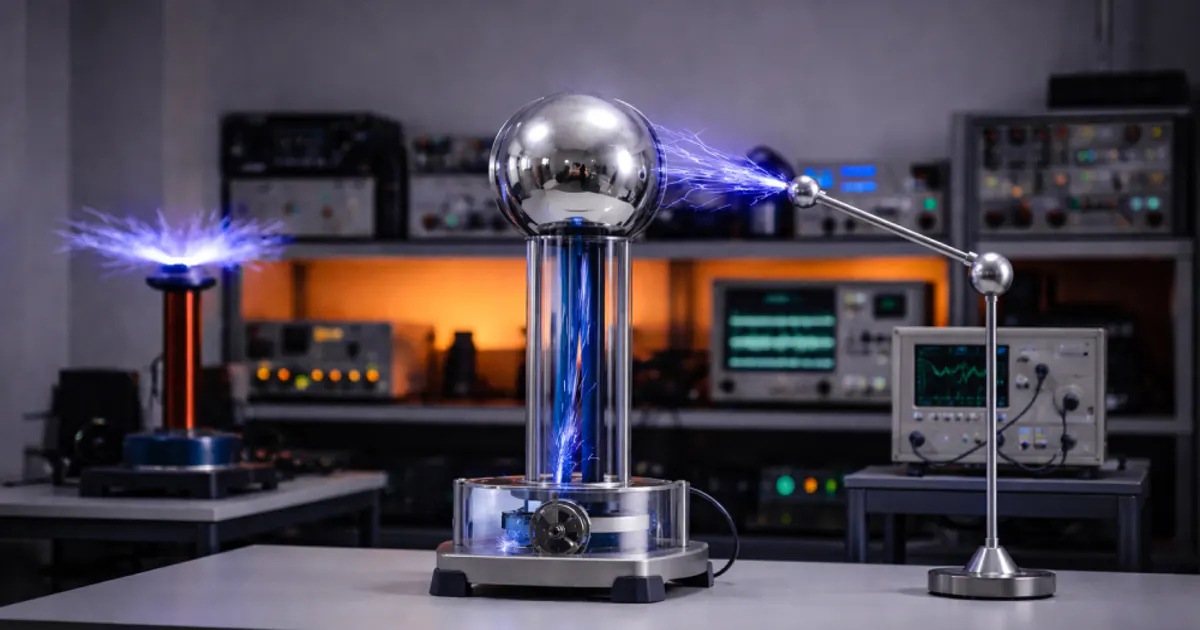
The most renowned high-voltage electrostatic generator is the Van de Graaff generator, easily recognized by its large metal sphere and the long sparks it creates.
This device was invented in 1931 by physicist Robert Van de Graaff for producing extremely high voltages in scientific research.
How the Van de Graaff Generator Works
The design is relatively simple:
- Lower roller
- Upper roller
- Insulating belt (rubber or synthetic)
- Metal brushes (combs)
- Hollow metal sphere
The belt moves continuously between the rollers. At the bottom, it receives an electric charge (typically through the triboelectric effect or induction), which it transports upward into the metal sphere. The brush at the top removes the charge from the belt and transfers it to the sphere, where it spreads evenly.
Why Use a Sphere?
The spherical shape is deliberate:
- No sharp edges
- Uniform electric field distribution
- Reduced risk of premature air breakdown
The larger the sphere's radius, the higher the voltage that can be stored before discharge begins.
Achievable Voltages
Laboratory Van de Graaff generators can produce:
- Hundreds of kilovolts
- Millions of volts
- Tens of megavolts in industrial accelerators
However, the current remains extremely small-usually in the microampere range.
Applications of the Van de Graaff Generator
Today, Van de Graaff generators are used in:
- Particle accelerators
- Nuclear physics
- Materials research
- Educational demonstrations
In accelerator technology, these systems accelerate charged particles to high energies using an electrostatic field.
Why Is It Unsuitable for Power Generation?
Despite their impressive voltages, Van de Graaff generators are limited in power output due to:
- Slow mechanical belt movement
- Air leakage
- Insulation breakdown
They are sources of high voltage, not high energy.
The Wimshurst Machine: A Classic Electrostatic Generator
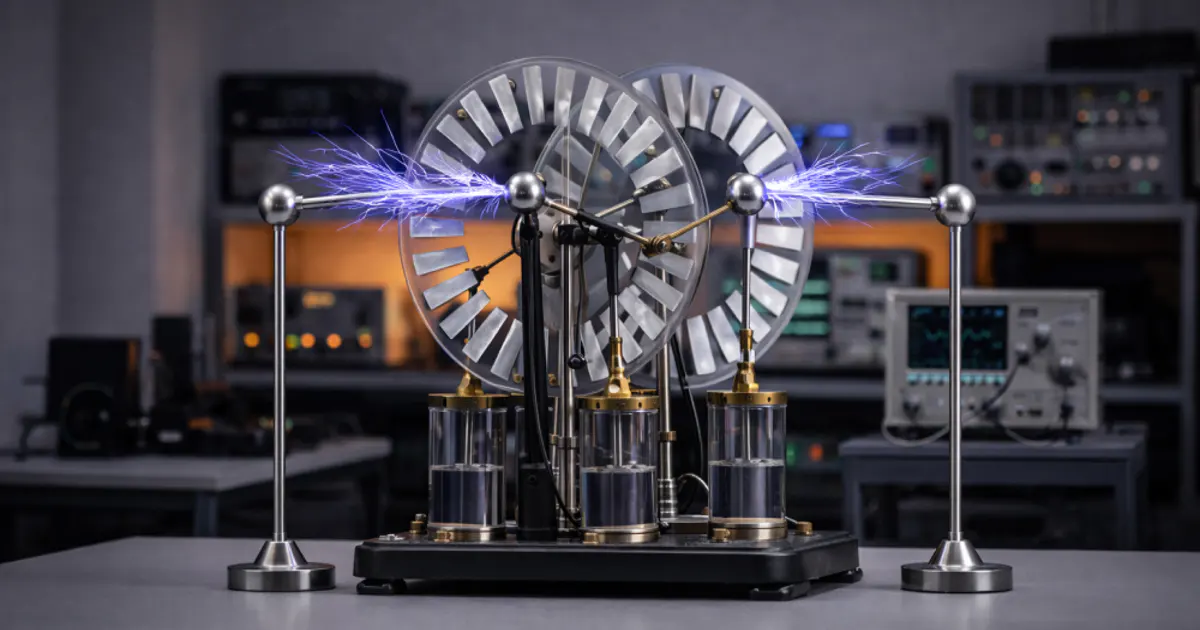
Another famous electrostatic generator is the Wimshurst machine. Unlike the Van de Graaff, it has no moving belt; instead, it generates charge via two rotating disks and electrostatic induction.
First developed in the late 19th century, it improved upon earlier electrostatic devices.
Operating Principle
The Wimshurst machine consists of:
- Two counter-rotating insulating disks
- Metal sectors on the surfaces
- Induction plates
- Collector brushes
- Leyden jars (capacitors)
As the disks spin, small random charges appear on the sectors. Cross-arranged induction plates amplify these charges-a process called self-excitation. As a result, one collector accumulates positive charge, the other negative, creating high voltage and dramatic sparks between them.
Design Features
- No external power source required
- Can operate without pre-charging
- Generates tens or hundreds of kilovolts
- Visually demonstrates electrical discharges
Like other electrostatic machines, the current remains extremely low-ideal for high-voltage, low-power applications.
Applications
- Educational settings
- Science museums
- Laboratory demonstrations
- Historical experiment reconstructions
The Wimshurst machine clearly illustrates how friction and induction can be turned into a controlled high-voltage source.
Can We Harvest Energy from Static Electricity?
The main question when exploring electrostatic machines is: if voltage can reach millions of volts, why don't we use them to power homes and cities?
The answer lies in the difference between voltage and power.
High Voltage ≠ High Energy
Electrostatic generators can create massive potential differences, but the current remains minuscule. Since power is calculated as P = U × I, even millions of volts with a microscopic current result in very little usable power.
This is why:
- Sparks are impressive
- Discharges are loud
- Voltage is enormous
- But the actual extractable energy is limited
Why Not Just Increase the Current?
In theory, increasing the rate of charge transfer sounds possible, but practical limitations arise:
- Leakage through air
- Insulation breakdown
- Surface currents on dielectrics
- Mechanical transfer speed limits
Higher voltage also accelerates charge loss due to corona discharge and micro-breakdowns.
What About Natural Static Electricity?
Some propose harnessing atmospheric charges or even lightning. However, the same principles apply:
- Lightning contains huge energy
- But it is dangerous and uncontrollable
- The energy density of atmospheric static fields is too low for industrial generation
Thus, energy from static fields remains a niche research area.
Where Does It Actually Work?
Modern technology uses similar principles on a miniature scale:
- Triboelectric nanogenerators
- Vibration energy harvesting devices
- Self-powered sensors
- IoT sensors
Here, only microwatts or milliwatts are needed-perfect for ultra-low-power electronics.
In this segment, electrostatic energy generation genuinely has a future.
Modern Electrostatic Technologies and Nanogenerators
While classic machines like the Van de Graaff are still used in labs, their core idea has evolved. Today, the focus is on microscale devices that require not kilowatts but microwatts.
The main direction: triboelectric nanogenerators (TENGs).
What Is a Triboelectric Nanogenerator?
The triboelectric effect is the transfer of electrons by contact and separation of two materials-commonly observed as "static from rubbing." Nanogenerators use:
- Thin polymer films
- Metallized layers
- Microstructured surfaces
- Flexible dielectrics
When surfaces touch and separate (via pressing, vibration, or bending), charge is generated and electronics convert this into an electrical signal. Unlike bulky 19th-century machines, modern devices can be coin-sized.
Applications of Electrostatic Generation
- Wearable electronics
- Medical sensors
- Self-powered sensors
- IoT systems
- Smart textiles
For instance, a person's step can generate enough energy to power a temperature sensor or an ultra-low-power Bluetooth module.
Why It Suits Microelectronics
The key advantage of modern systems is the combination of:
- Ultra-low energy consumption electronics
- Supercapacitor storage
- Pulsed operation
Devices accumulate charge and transmit data periodically, making electrostatic generation a part of the broader "energy harvesting" concept-capturing ambient energy from the environment.
New Materials
Progress has accelerated thanks to:
- Nano-structured polymers
- Graphene coatings
- Flexible conductive materials
- 3D-printed microelectrodes
Surface microrelief increases contact area and boosts charge transfer efficiency.
Limitations of the New Generation
Despite advances, challenges remain:
- Material degradation
- Instability in high humidity
- Low power density
- Scaling difficulties
So, while these technologies won't replace power plants, they are perfect for autonomous microsystems.
Physical Limits of Electrostatic Generation
Despite their dramatic sparks and million-volt outputs, electrostatic generators are constrained by fundamental physical laws. These limits prevent static electricity from becoming a widespread energy source.
Air Breakdown Threshold
The first limitation is the dielectric strength of the environment. For air, the critical field is roughly 3 kV per millimeter, meaning:
- Corona discharge starts at the threshold
- Charge leakage occurs
- Sparks break through
Retaining high voltage gets harder as it rises. To push the limits, one needs:
- Vacuum
- Inert gases
- Larger electrode radii
- Perfect insulation
Even in ideal conditions, losses persist.
The Law of Energy Conservation
An electrostatic generator doesn't create energy from nothing. It merely converts:
- Mechanical rotation
- Movement
- Material contact energy
...into electricity. If mechanical input is small, electrical output cannot be greater. High voltage gives the illusion of great energy, but current remains limited.
Storage Capacity
Every electrode has capacitance. The energy stored in an electric field is calculated as:
W = ½ C U²
Even with high voltage, if the capacitance (C) is low, stored energy is minimal. Increasing capacitance means larger sizes, massive spheres, and complex insulation.
Leakage and Surface Currents
No material is a perfect insulator. There will always be:
- Air humidity
- Surface contamination
- Microcracks
- Leakage currents
These effects intensify exponentially as voltage rises.
Scaling: The Main Barrier
The main challenge is scaling up power. To increase output energy, you need to:
- Transfer charge faster
- Increase contact area
- Speed up mechanics
- Improve insulation
Each step faces material and environmental limitations. As a result, electrostatic technologies remain:
- Sources of high voltage
- Scientific tools
- Solutions for ultra-low-power systems
- but not alternatives to turbines, generators, or solar power plants.
The Future of Electrostatic Generators
Despite physical constraints, electrostatic technology is far from obsolete. In the era of microelectronics and autonomous systems, it is experiencing a renaissance.
The focus is shifting from increasing power to improving efficiency, miniaturization, and environmental integration.
Integration into Everyday Materials
An exciting direction is embedding triboelectric layers into:
- Clothing
- Footwear
- Pavement
- Building materials
- Interior elements
For example, a floor could partially convert footsteps into energy for lighting sensors or monitoring systems. This won't replace the power grid, but it can create self-sustaining, low-power infrastructure.
Hybrid Systems
Combining:
- Triboelectric generators
- Piezo elements
- Solar micro-panels
- Thermoelectric modules
...creates hybrid systems that simultaneously harvest energy from movement, light, heat, and vibration-boosting the reliability of autonomous devices.
New Materials and Nanostructures
The technology's future depends on:
- Metamaterials
- Nanotextured surfaces
- Ultra-thin dielectrics
- Durable polymer composites
Surface engineering can greatly enhance charge density without increasing device size.
Space and Extreme Applications
Interest in electrostatic systems continues in space technology:
- Vacuum environments make high potentials easier to maintain
- No air breakdown
- Compact accelerator installations possible
Such technologies are also used in scientific instruments and sensors for harsh environments.
Realistic Development Scenarios
The most likely future for electrostatic generators includes:
- Battery-free IoT networks
- Self-charging medical implants
- "Smart" materials
- Micro-power supply for distributed sensors
Electrostatic generator technology won't power the world, but it will secure a niche in distributed micro-energy systems.
Conclusion
Electrostatic generators are among the most illustrative and underappreciated technologies in electrical engineering history.
From 19th-century machines to modern triboelectric nanogenerators, the principle remains the same: accumulating and controlling electric charge.
Although high power is unattainable for electrostatic systems due to physical limits-air breakdown, leakage, and low capacitance-they are perfectly suited for applications needing ultra-high voltage or autonomous micro-power.
As the world sees more sensors, wearable electronics, and distributed devices, such technologies may become an invisible but vital part of the future energy ecosystem.
Tags:
Similar Articles