Steer-by-Wire Explained: How Electronic Steering Transforms Modern Cars
Steer-by-Wire replaces traditional mechanical steering with advanced electronic systems using sensors, controllers, and actuators. This technology enables adaptive steering, customizable feedback, and innovative vehicle designs, but also demands robust safety strategies and redundancy.

Steer-by-Wire is an electronic steering technology where the rotation of the steering wheel is transmitted to the wheels via electrical signals, not through a traditional mechanical connection. Instead of a steering shaft directly linking the wheel to the steering mechanism, the system relies on sensors, electronic controllers, and electric actuators.
What Is Steer-by-Wire and How Does It Differ from Traditional Steering?
In a conventional car, the steering wheel is mechanically linked to the front wheels through a shaft, joints, and rack-and-pinion mechanism. Turning the wheel physically moves these components, altering the wheels' direction.
Even with modern Electric Power Steering (EPS), the mechanical link remains, with an electric motor only assisting the driver. If the assist fails, steering remains possible-just heavier.
Steer-by-Wire takes a different approach. The steering wheel no longer needs a direct mechanical link to the steering rack. Instead, the system reads the driver's input and translates it into electronic commands that control electric actuators at the wheels.
Key Differences in Control Transmission:
- Mechanical steering: Driver force is transmitted to the wheels through shafts, gears, and rods.
- EPS: Mechanical link is retained; the electric motor simply assists.
- Steer-by-Wire: Control is fully electronic; actuators generate the necessary force for wheel movement.
By removing the mechanical connection, steering is split into two independent modules: the command input (steering wheel) and the actuator mechanism at the wheels, linked by an electronic control system.
This enables features impossible with conventional systems-for instance, adjusting the steering ratio dynamically based on speed. Minimal steering input is needed for parking, while at high speeds, the system can dampen responsiveness for stability.
Why Are Manufacturers Shifting to Electronic Steering?
One reason for the move to Steer-by-Wire is greater design flexibility. A traditional steering shaft constrains cabin layout and component placement. Electronic systems lift many of these restrictions, allowing creative design of steering modules, dashboards, and driver seating.
Another benefit is software-based tuning: steering sensitivity, effort, and vehicle response can be adjusted without mechanical changes. This is especially valuable for vehicles with advanced driver-assistance systems (ADAS), as electronic steering enables seamless integration between human and automated control-though Steer-by-Wire alone does not make a vehicle self-driving.
However, fully electronic steering requires robust safety engineering. Without a mechanical fallback, steering depends entirely on electronics, actuators, and power supply. Redundancy and special fault algorithms are critical to ensure reliability.
How Steer-by-Wire Works: From Steering Wheel to Road Wheels
At its core, Steer-by-Wire converts the driver's steering wheel movement into electronic signals. Instead of transmitting torque mechanically, it uses sensors, controllers, and electric motors to position the wheels.
As the driver turns the wheel, the system detects the direction and degree of rotation, calculates the necessary wheel angle, and commands the actuators accordingly. This loop repeats continuously, adapting to driver input and driving conditions.
Sensors, Electronic Control Unit, and Actuators
- Steering position sensors: Detect steering wheel direction and angle.
- Electronic Control Unit (ECU): Processes input signals and computes actuator commands, considering vehicle speed, current steering position, and system settings.
- Steering actuator: Generates the force to turn the wheels.
- Actuator position sensors: Monitor the actual position of the steering rack or wheels.
- Force feedback actuator: Creates resistance in the steering wheel, simulating road feel.
The system operates in a closed-loop fashion: the controller constantly compares the commanded and actual wheel positions, making corrections as needed. This method, inspired by aviation's fly-by-wire systems, enhances precision and allows for advanced safety checks.
For more about similar technologies in aviation, see the article How Fly-by-Wire Revolutionized Aircraft Control Systems.
How Does the Driver Feel the Road Without Mechanical Linkage?
One of the defining aspects of Steer-by-Wire is the absence of natural mechanical feedback. In conventional cars, forces at the tire-road interface are transmitted through the steering gear, creating resistance and centering forces on the wheel.
With electronic steering, this feedback is simulated by a dedicated electric motor in the steering module. The controller calculates the appropriate resistance based on vehicle dynamics, wheel position, and steering load, then generates the corresponding torque at the wheel.
For example, at low speeds or during parking, the system can reduce steering effort for ease. At high speeds, resistance is increased for stability and precision. Electronic feedback also allows for filtering unwanted vibrations, letting only useful information through according to manufacturer settings.
Variable Steering Ratio
Unlike traditional mechanisms, where the steering ratio is fixed by hardware, Steer-by-Wire sets it in software. At low speeds, small wheel movements can produce large wheel angles for maneuverability; at high speeds, the same input results in smaller wheel angles for safety and control.
This means drivers rarely need to reposition their hands during maneuvers. However, the overall feel and precision depend on the system's engineering, with different implementations offering varying degrees of feedback fidelity.
Steer-by-Wire: Advantages and Drawbacks
Switching to Steer-by-Wire fundamentally changes how steering commands are transmitted, offering unprecedented flexibility but also introducing new dependencies on electronics and power systems.
Main Advantages
- Adaptive steering sensitivity: The system can change the steering ratio based on speed-fewer turns while parking, smoother response at highway speeds.
- Customizable feedback: Electronic force feedback allows for tuning the steering feel from light and comfortable to firm and sporty.
- Reduced unwanted vibrations: No direct mechanical link means fewer shocks and road vibrations reach the driver.
- Flexible vehicle design: No need for a steering shaft enables innovative cabin layouts and new steering wheel designs.
- Integration with electronic systems: Steer-by-Wire seamlessly works with stability control and driver-assistance features.
Variable steering ratio is particularly noteworthy: tight maneuvers can be executed with minimal wheel movement, while highway driving remains steady and predictable. Manufacturers can even offer different steering profiles via software, though changes are still bounded by safety and vehicle architecture.
Key Limitations
- System complexity: Reliable operation requires precise sensors, powerful controllers, actuators, and sophisticated software.
- Power reliance: Without electricity, steering fails-backup solutions are essential.
- Higher component costs: Extra electronics, redundancy, and specialized actuators increase development and production expenses.
- Diagnostic and repair challenges: Issues may stem from hardware, sensors, wiring, or software, complicating troubleshooting.
- Artificial road feel: Feedback is synthesized and may differ from traditional mechanical sensations.
One of the greatest engineering hurdles is ensuring a predictable response-there must be no perceptible delay between steering input and vehicle reaction. Rapid signal processing and actuator precision are vital, as is software capable of distinguishing useful road feedback from noise. Importantly, Steer-by-Wire doesn't eliminate all mechanical parts-steering racks, rods, and joints still connect actuators to wheels, so overall complexity and weight may not decrease.
Is Steer-by-Wire Safe? What Happens During Electronic Failure?
The core safety concern with Steer-by-Wire is the lack of a permanent mechanical link. In traditional cars, even if power assist fails, the driver can still steer. With Steer-by-Wire, steering depends entirely on electronics, actuators, and power supply.
To address this, manufacturers design systems with fail-operational architectures, aiming to preserve steering control during partial failures and prevent sudden loss of steering.
How Electronic Redundancy Works
- Redundant sensors: Multiple independent channels detect steering input, allowing for error checking and backup.
- Duplicated controllers: Extra processing units take over if the primary fails.
- Independent data channels: Multiple communication paths reduce the risk of complete steering loss due to a single fault.
- Backup power: Secondary power supplies keep critical functions operational during main power failures.
- Resilient actuators: Some systems can maintain limited or full function even after partial actuator failure.
Redundancy doesn't mean duplicating every part-designs vary by manufacturer, vehicle, and intended fault scenarios. Electronic control units constantly monitor system health, cross-checking sensor data and actuator performance. If inconsistencies arise, the system can isolate faulty components and enter a safe mode, limiting features but maintaining core steering capability.
What If Steer-by-Wire Fails?
The outcome depends on which component fails and how extensive the damage is. Loss of a single sensor usually triggers backup systems. More severe failures may restrict steering functions or, in rare cases, result in loss of steering if multiple redundancies fail.
Power supply failure is a particular concern, so Steer-by-Wire systems incorporate special backup power solutions. Still, total system failure-such as multiple simultaneous faults or power system collapse-can create dangerous situations.
Why Continuous Diagnostics Are Essential
Safety in Steer-by-Wire relies not only on hardware redundancy but on smart software able to detect and react to malfunctions. The system must spot discrepancies between intended and actual wheel positions, detect jamming or actuator faults, and respond appropriately-by switching to backups, entering failsafe modes, or alerting the driver.
Development follows strict automotive safety standards, including ISO 26262, which require risk analysis and technical measures to reduce the likelihood of hazardous outcomes. For example, the Lexus RZ features redundant controls and backup power, allowing continued safe steering even if some components fail. Ultimately, Steer-by-Wire's safety depends on robust engineering and constant system monitoring.
Where Is Steer-by-Wire Used and What's the Future?
Despite its complexity, Steer-by-Wire is already present in production vehicles, especially EVs where electronic systems are central to vehicle operation and design innovation.
Lexus RZ: One Motion Grip Electronic Steering
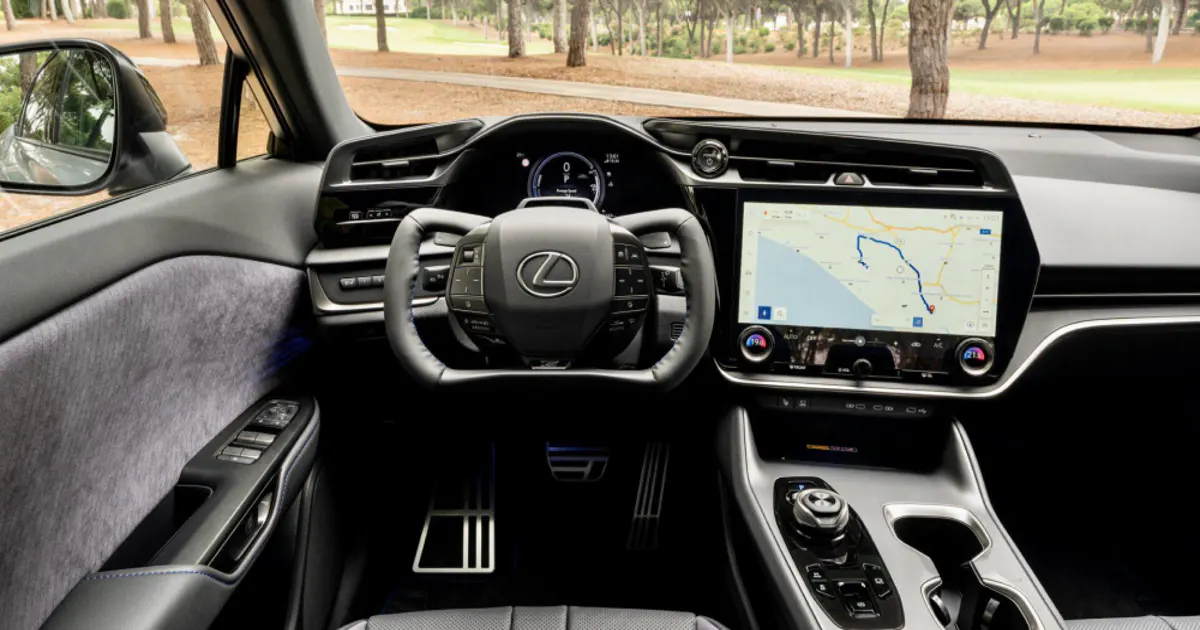
The Lexus RZ electric crossover features the One Motion Grip system, which eliminates the mechanical link between steering wheel and front wheels. Commands are relayed via electronic controllers, and the uniquely shaped, compact steering wheel resembles an aircraft yoke. Thanks to Steer-by-Wire, the steering's full range is limited to about 200 degrees, so the driver needn't reposition hands for ordinary maneuvers.
Sensitivity adapts to speed: small steering inputs at low speeds yield large wheel angles for easy parking, while at highway speeds the system mutes inputs for smoother control. A dedicated actuator generates road feel, providing driver feedback and filtering unwanted vibrations.
Tesla Cybertruck: Steer-by-Wire and Four-Wheel Steering
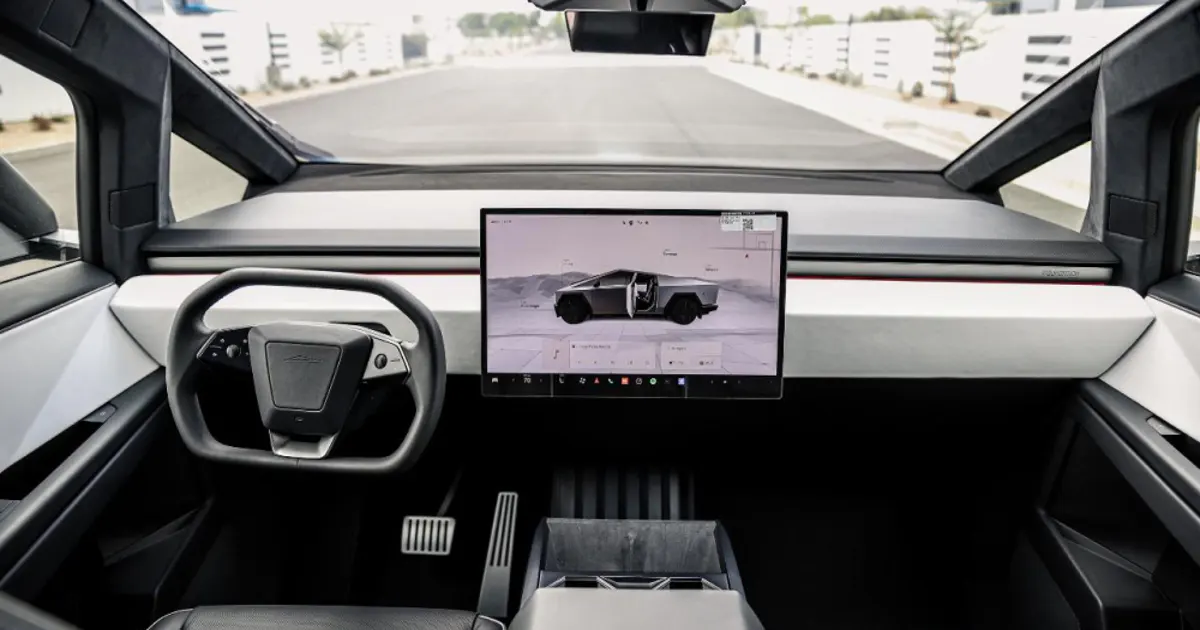
The Tesla Cybertruck pairs Steer-by-Wire with four-wheel steering, enhancing the truck's agility. The steering wheel is not mechanically linked to the wheels; driver input is sensed and routed to front and rear actuators via electronic controllers.
- Steering ratio varies with driving conditions.
- Front and rear wheels can steer in coordination for better handling.
- At low speeds, rear wheel steering tightens the turning radius.
- Full lock-to-lock steering requires less than one full turn of the wheel.
The Cybertruck's steering wheel rotates about 340 degrees-much less than typical cars. Note that Steer-by-Wire transmits driver commands electronically, while rear-wheel steering is a separate feature; they are complementary but distinct technologies.
Why Isn't Steer-by-Wire Mainstream Yet?
The main obstacles are the complexity of fail-safe engineering and cost. Traditional steering is cheap, reliable, and well understood. Steer-by-Wire adds electronics, redundancy, and diagnostic procedures, raising costs.
Moreover, for many drivers, EPS already provides sufficient comfort and variable effort, so the benefits of full Steer-by-Wire may not justify the expense-unless a manufacturer wants to enable new design possibilities or advanced vehicle automation.
The Future of Electronic Steering
Looking ahead, Steer-by-Wire may become a foundational technology for highly automated vehicles. Electronic steering allows more flexible integration between driver and assistance systems, and enables novel cabin and control layouts-potentially even retractable or non-traditional steering wheels if safety and automation standards are met.
Nevertheless, widespread adoption will depend on lower costs, increased reliability, and the ability to deliver natural driving feel. Steer-by-Wire can be implemented with familiar round steering wheels, preserving ergonomics while revolutionizing the underlying mechanism.
Conclusion
Steer-by-Wire transforms automotive steering by replacing mechanical linkages with sensors, controllers, and actuators. This enables programmable sensitivity, customizable feedback, and greater flexibility in vehicle design and response.
Key benefits include adjustable steering feel, reduced steering effort, and new opportunities in cabin configuration. Yet, removing the mechanical link places greater demands on electronic reliability, redundancy, and power management.
The Lexus RZ and Tesla Cybertruck demonstrate that Steer-by-Wire is moving beyond prototypes. While currently a premium solution, the technology's main value lies not in eliminating the steering shaft, but in giving manufacturers and drivers precise, adaptable control over vehicle dynamics-pointing to a future where steering is safer, smarter, and more flexible.