Magnetohydrodynamic Generators: How Electricity Is Made Without Turbines
Magnetohydrodynamic (MHD) generators offer a way to produce electricity directly from heat, without any moving mechanical parts like turbines or shafts. This technology harnesses the movement of plasma or liquid metal through magnetic fields, potentially increasing efficiency and reliability for high-temperature power generation. While MHD generators face engineering and economic challenges, they hold promise for nuclear, fusion, and space energy systems of the future.

Magnetohydrodynamic generator (MHD generator): how does this technology work, and is it really possible to produce electricity without turbines? The foundation of modern power generation is built almost entirely on rotating machinery - steam spins a turbine, which in turn drives a generator to produce electricity. But can we generate current without turbines, shafts, or bearings? That's precisely the problem a magnetohydrodynamic generator solves: a device capable of directly converting heat into electricity.
The magnetohydrodynamic generator doesn't rely on mechanical rotation. Instead, it harnesses the movement of a conductive medium - plasma or liquid metal - within a magnetic field. This produces electrical current without any intermediate mechanical stage. In theory, this approach can increase efficiency and reduce equipment wear and tear.
The concept of directly converting heat into electricity through magnetohydrodynamics was actively studied in the 20th century as an alternative to classic turbine-based setups. Today, interest in this technology is growing again as the world searches for next-generation energy solutions.
What is a Magnetohydrodynamic Generator?
An MHD generator is a device that generates electricity by moving a conductive medium through a magnetic field. Unlike conventional generators, it contains no rotating parts: no turbines, rotors, or shafts.
The core of the technology is magnetohydrodynamics, the branch of physics studying the behavior of electrically conductive fluids and plasmas in magnetic fields. When hot, ionized gas or liquid metal flows through a powerful magnetic field, the Lorentz force acts on the charged particles, deflecting electrons and ions in opposite directions. This creates a potential difference between electrodes - resulting in electricity.
In essence, an MHD generator directly converts heat into electricity. First, thermal energy is transformed into the kinetic energy of a plasma (or liquid metal) flow, then immediately into electrical energy - skipping the mechanical stage entirely.
There are several types of MHD generators:
- Plasma-based MHD systems
- Liquid metal MHD systems
- Open and closed cycle configurations
Theoretically, such designs can offer higher efficiency than traditional thermal power plants, where significant energy is lost during mechanical conversion stages.
How It Works: Lorentz Force and Conductive Media
The operation of an MHD generator is based on the physical law governing the interaction of moving charged particles with a magnetic field. When a conductive medium - plasma or liquid metal - moves through a magnetic field, the Lorentz force acts on its free electrons and ions.
To simplify, here's how the process unfolds:
- A heat source (such as fuel combustion or a nuclear reaction) heats the working medium to a very high temperature.
- The gas ionizes and becomes plasma - an environment with high electrical conductivity.
- The plasma flow is directed through a channel where a strong magnetic field is established.
- Charged particles are deflected by the magnetic field.
- A potential difference appears between electrodes placed along the channel - generating electrical current.
The key is that electricity is produced directly from the movement of charged particles. There is no rotor spinning in a magnetic field as in a traditional generator; instead, the flow of the conductive medium itself acts as the "moving conductor."
This is why the MHD generator is classified as a direct energy conversion technology. There are no losses from friction, mechanical wear, or turbine inertia, in theory leading to greater overall efficiency - especially at very high temperatures.
However, effective operation requires extreme conditions: temperatures of thousands of degrees and powerful magnetic fields. These requirements have been the main engineering challenge in the development of MHD technology.
MHD Generator Diagram
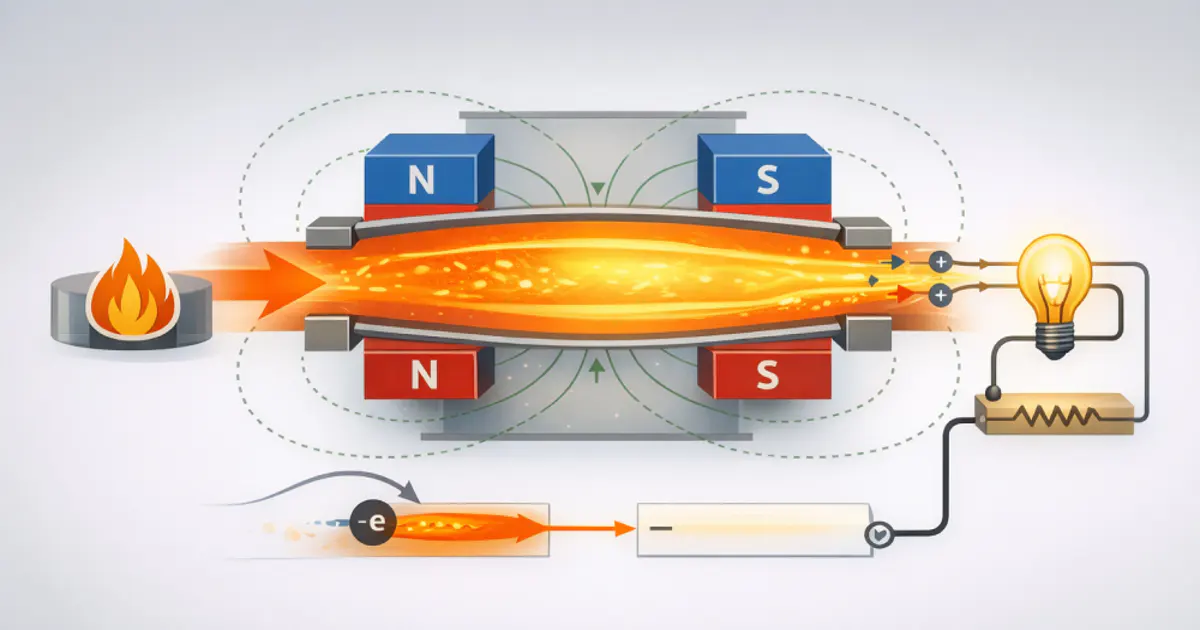
The schematic for an MHD generator is mechanically simpler than a traditional turbine power plant, but more complex in terms of physical processes. At its core: a channel for the high-temperature conductive medium, a magnetic field generation system, and electrodes to collect the current.
A typical system features several key components:
- Heat source. This could be a combustion chamber, reactor, or another high-temperature energy source. Its role is to heat the working medium to plasma state or provide high conductivity for a liquid metal.
- Acceleration channel. The heated gas expands and moves rapidly through a special channel. Inside, a powerful magnetic field is created - usually using superconducting magnets.
- Magnetic system. Magnets generate a field perpendicular to the flow direction. This is where the magnetohydrodynamic energy conversion occurs.
- Electrodes. Placed on the sides of the channel, these collect the electrical current generated as charged particles are deflected by the Lorentz force.
Unlike standard generators, where mechanical rotation creates a changing magnetic field, in MHD generators, the moving plasma itself crosses a stationary field. That's how electricity is generated without turbines or rotating parts.
From an engineering standpoint, the design is compact but demands heat-resistant materials capable of withstanding extreme temperatures and aggressive plasma. The interaction between high temperatures, strong magnetic fields, and electrodes has been a central challenge for industrial-scale MHD installations.
Advantages and Limitations of MHD Generators
The magnetohydrodynamic generator is often called a direct heat-to-electricity technology because it genuinely operates without turbines, shafts, or bearings. Theoretically, this brings a number of significant advantages compared to classic thermal power stations.
Main advantage: no moving parts. An MHD generator without rotating machinery doesn't need complex mechanical systems, gearboxes, or constant turbine maintenance. This reduces wear, minimizes vibration, and potentially boosts reliability. For high-temperature power generation, this is crucial: a plasma flow at thousands of degrees would quickly destroy mechanical blades, but not a magnetic field channel.
Second advantage: high theoretical efficiency. MHD energy conversion extracts electricity directly from the kinetic energy of the ionized flow. In hybrid schemes, an MHD power plant can work alongside a classic steam turbine cycle: the plasma first yields some energy in the MHD channel, then the remaining heat is used to generate steam. This cascading approach can increase overall plant efficiency.
Third advantage: scalability and flexibility of the working medium. There are both open and closed cycle MHD designs. Open cycles use combustion products, while closed cycles circulate inert gas or liquid metal. Liquid metal MHD generators can operate at lower temperatures than plasma versions, while still maintaining conductivity.
However, the technology does face serious challenges in practice:
- Extreme temperatures. Effective plasma generation requires heating to several thousand degrees and often seeding with alkali metals to boost conductivity. This complicates the design and raises material requirements.
- Materials and erosion. Channel walls, electrodes, and insulation are subject to intense thermal and electromagnetic stress. High-power magnetic fields, strong currents, and an aggressive plasma environment result in rapid component wear.
- Superconducting magnet costs. Powerful, stable magnetic fields require massive magnet systems, often with cryogenic cooling - making MHD power plants technically complex and expensive.
- Economic factors. Despite its promise, traditional turbines have become highly efficient and refined over decades. Any alternative must be not only technically viable but also economically justified - a gap MHD has yet to bridge.
Still, the vision of future energy without turbines persists. Advances in heat-resistant materials, composites, ceramics, and superconductors could bring magnetohydrodynamics back into the energy spotlight.
The Development of MHD Generators: From Soviet Experiments to Modern Research
The idea of the magnetohydrodynamic generator emerged in the mid-20th century, as physicists explored plasma behavior in magnetic fields. The Lorentz principle was already well-known from electrodynamics, making it a logical step to apply these laws to direct electricity generation.
The technology reached its peak in the 1960s-80s, with intense research in the USSR and the US. In the Soviet Union, experimental MHD power plants were built using open cycles with combustion products and alkali metal additives to improve plasma conductivity. Large-scale plasma power stations were planned as part of thermal energy blocks.
The US also ran its own MHD generator programs, aiming to increase coal plant efficiency. The idea was to first extract energy from hot, ionized gas in the MHD channel, then use the remaining heat in a traditional turbine - a potentially revolutionary approach to direct heat-to-electricity conversion.
However, interest in the technology declined sharply in the 1990s due to:
- High costs of magnetic systems
- The complexity of working with plasma at extreme temperatures
- Rapid electrode wear
- Economic instability and reduced research funding
Classic turbine setups proved cheaper and simpler for mass deployment.
Still, research didn't vanish completely. In the 21st century, the MHD generator is again considered in the context of future energy. Modern projects are less about giant coal plants and more about:
- Next-generation nuclear power
- Fusion installations
- Space-based energy systems
- Compact plasma reactors
Particular interest surrounds liquid metal MHD generators, especially for use with fast nuclear reactors, where the coolant itself is a liquid metal. In such setups, the conductive medium is already present, simplifying MHD integration.
Today, the technology isn't viewed as a complete replacement for conventional energy, but as a specialized solution for high-temperature sources, where turbines are pushed to their limits.
Where MHD Generators Could Be Used in the Future
While the classic MHD power plant never became mainstream, the idea of direct heat-to-electricity conversion remains extremely appealing - especially where temperatures are so high that turbines are at the edge of feasibility.
Next-Generation Nuclear Power
Fourth-generation reactors and fast reactors with liquid metal coolant already use a conductive medium - sodium or lead. In theory, a liquid metal MHD generator could be incorporated into the cooling circuit to produce electricity directly, bypassing the intermediate steam cycle.
This reduces energy conversion stages, cuts losses, and simplifies plant architecture. In the future, such solutions could be key to compact, modular reactors where reliability and minimal mechanical complexity are vital.
Fusion Installations
If humanity achieves industrial-scale fusion power, high-temperature electricity generation will become a critical issue. Plasmas in reactors reach millions of degrees, making classic turbines dependent on complex intermediate cooling circuits.
Magnetohydrodynamic energy conversion could extract power directly from plasma flows or high-temperature coolant - a major advantage for compact fusion reactor concepts.
Space Energy Systems
In space, a generator with no moving parts is a significant advantage. Mechanical assemblies in vacuum, under temperature swings and radiation, are prone to wear and require complex maintenance.
MHD generators can be integrated into nuclear space energy systems or plasma propulsion, where ionized flows are already present. In such conditions, an MHD generator is a logical extension of existing plasma technology, not an exotic outlier.
Hybrid Power Plants
Another avenue is combined-cycle plants, where an MHD stage acts as the "top step" before the turbine: first, energy is extracted via the magnetic field, then the remaining heat is fed to a classic steam cycle.
This can raise overall plant efficiency, especially when burning coal or synthetic fuels with high combustion temperatures.
In summary, MHD generators have not vanished from the energy landscape. Instead, they've evolved from an ambitious turbine alternative into a niche but potentially strategic technology for extreme, high-temperature environments.
Conclusion
The magnetohydrodynamic generator remains one of the most ambitious concepts in the history of power engineering. The idea of generating electricity without turbines, shafts, or moving parts seems almost futuristic. Direct heat-to-electricity conversion via the interaction of conductive plasma and magnetic fields is not science fiction, but a physically demonstrable technology.
Yet, reality has proven more difficult than theory. Extreme temperatures, material wear, the high cost of magnetic systems, and competition from mature turbine technologies have slowed the adoption of MHD power plants. They never became mainstream in global energy.
Still, the idea endures. In the context of a future without turbines - in fusion reactors, space energy systems, and next-gen nuclear plants - magnetohydrodynamic energy conversion is once again relevant. Wherever temperatures are extreme and mechanical systems are the weak link, a generator with no moving parts may be the optimal solution.
It's unlikely that MHD generators will replace turbines everywhere. But in the niche of high-temperature electricity generation - especially in nuclear and plasma applications - they could play a key role.
The story of this technology is a reminder that sometimes ideas are ahead of their time. With the development of new materials, superconductors, and plasma technologies, magnetohydrodynamics may yet make a comeback in large-scale energy - in a new, more advanced form.
Tags:
Similar Articles